
Is your team suffering due to messy data? Lack of visibility into lead touchpoints? CRM user adoption issues?
Sounds like you and your team have a hole in your life. One that adoption software could fill.
Of course, we’re talking about digital adoption here. A concept that sounds like you’re gaining legal guardianship of a chatbot, but is really about regaining ROI from your online sales tools (including, yes, chatbots).
A digital adoption platform (DAP) can help solve all of those sales and marketing issues by embedding your best practices directly into the tools your team already uses. This ensures the right actions happen at the right time – without relying on memory or manual enforcement.
Intrigued? We’ll share our adoption software experiences and use cases below. From there, you can judge for yourself whether you’re ready to add a new bundle of efficiency-fueled joy to your B2B family.
The Cost of Poor User Adoption
Digital adoption is the process of users learning and using new software, systems, and apps to their full potential. Sadly, for many team members the process dies somewhere between “learning” and “full potential.”
|
Inconsistent tool/process adoption results in: |
|
|
⌛ Wasted time |
▪️Marketers build assets that never get used ▪️New hires take months to onboard ▪️Manager spend time policing, not coaching |
|
📊 Bad info |
▪️Reps use outdated decks or messaging ▪️CRM fields filled out inconsistently |
|
😤 Frustrated teams |
▪️Tribal knowledge inaccessible to others ▪️High turnover rate |
|
💸 Lost money |
▪️Slow sales cycles ▪️Lower win rates ▪️Inconsistent customer experience |
Of course, some of these bad results have overlapping systems. If onboarding takes 2 extra months per sales rep, that’s not just a waste of time, that’s also missed opportunities for the trainer to be doing their real job – selling.
What Do Digital Adoption Platforms Do?
A digital adoption tool is a piece of software … for software. Think of it as a personal digital assistant that’s embedded directly into wherever your team works.
That can be anything with a URL:
- Gmail
- HubSpot & Salesforce
- Your ERP
A digital adoption platform exists as a “layer” on top of another platform, website, or piece of software. It delivers real-time support such as “how-to” hand-holding, notifying users about missed steps, and sharing relevant resources. This can play out in many different ways based on your needs.
- A variety of “guard rails”: In-app prompts, checklists, triggers, & tooltips
- Contextual rules: Based on deal stage, buyer persona, task, etc.)
- Personalized help: Based on level of experience and familiarity
The goal is acceleration in both proficiency and efficiency.
Examples of a DAP’s Features
Ideally, a DAP product’s mission is to remove friction, not add control. That’s where an adoption platform’s value lies; your team doesn’t want “yet another tool” unless it’s going to actually make life easier.
What’s a digital adoption solution look like in practice? The concept might still feel abstract to you, so we'll use a real-life example: Supered.io. (It’s the platform we use ourselves.)
Cards
For: Information ➜ Context, delivered in-workflow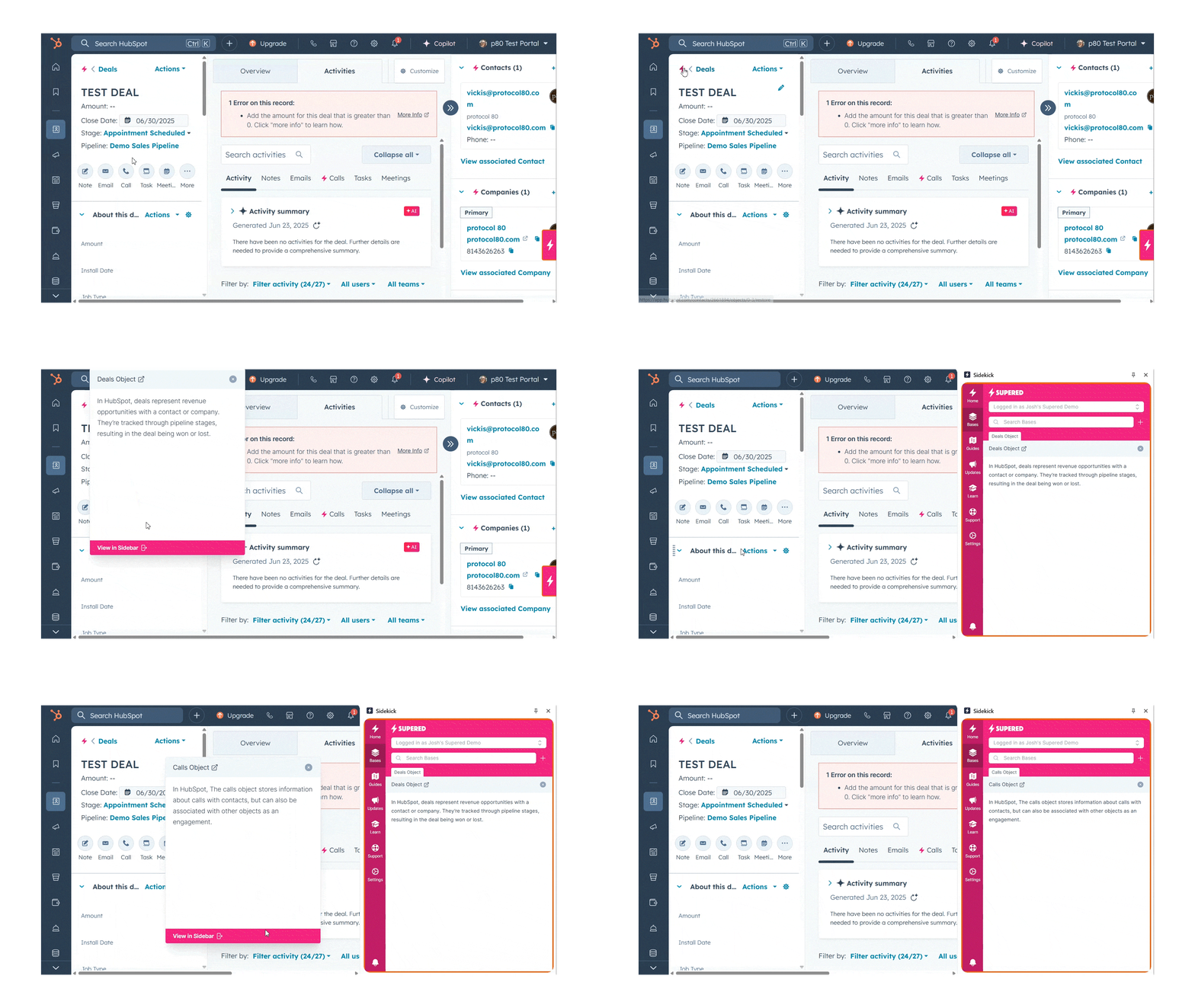 Cards are the foundational layer of how you deliver information inside a platform like Supered. Think of them as bite-sized, contextual pieces of knowledge that appear directly inside your team’s tool, such as a CRM (customer relationship management) system. This context could be in the form of:
- Playbooks
- Reminders
- Links
- Best practices
Instead of forcing reps or marketers to search through a wiki or remember where documentation lives, Cards enter the scene automatically. They can be triggered based on specific pages, actions, or conditions.
From a strategic standpoint, Cards reduce context switching, eliminate CRM and Google Drive scavenger hunts, and improve process adherence. Speaking of which …
Process Rules
For: Enforcement ➜ Real-time standardization
If Cards are about delivering knowledge, Process Rules are about ensuring your team uses that knowledge for good.
In our example DAP, Process Rules define what should (or shouldn’t) happen within a system – flagging errors, enforcing steps, or guiding users toward the correct action. Often they’re the equivalent of shouting “You shall not pass" like that white-haired wizard fella from Lord of the Rings.
For example, Process Rules can:
- Keep reps from skipping mandatory CRM fields
- Validate data
- Show a warning when something is off-track
What makes this powerful is that enforcement happens in real time – not after the fact in a report. Instead of managers chasing down mistakes or inconsistencies, the system itself course-corrects the reps’ path.
See Also: Process Boards
Process Boards allow you to report on Process Rule violations. They help you see which team members may need more coaching to ensure they follow your internal protocols and rules.
Some users refer to Process Boards as "zero boards," with the end goal being zero violations across all reps.
Guides
For: Execution ➜ Step-by-step training Guides are where process adoption becomes action. They provide walkthroughs for even the most complex or multistep process.
Rather than relying on one-time training sessions or a 19-page document, Guides allow users to learn by doing. Here are some neat examples:
- Sales: Walking a rep through a discovery call workflow
- Marketing: Campaign setup in HubSpot
- Training: Guided support for new hires
You can set guides to be triggered by deal stage, account type, and so on.
This customizability turns training from a separate activity into an embedded experience. It shortens ramp-up time and reduces errors, even for infrequent or tricky tasks.
B2B Use Cases for Process Adoption Platforms
Now you’re familiar with the theory of process software, and perhaps pick up on a few potential use cases for your team. But let’s dig a little deeper into how exactly you can extract value from an adoption tool.
In-App Documentation |
Process
|
Change Management |
|
✔️ Company standard operating procedures ✔️ Process definitions (Lifecycle Stages, Deal or Ticket Pipelines, etc.) ✔️ Data dictionary or flow charts |
✔️ Property descriptions ✔️ Real-time feedback for data entry or associations ✔️ Guidance on next steps (closing deals, resolving tickets, etc.) |
✔️ Product or pricing updates ✔️ HubSpot process changes ✔️ New employee onboarding ✔️ Launching a campaign |
|
Educate your team |
Enable your team |
Enforce your process |
Documentation
Chances are, very few team members are consistently referencing whatever documentation you poured your soul into. Sad, we know.
Before giving up on ever having a cohesive process, try using a DAP as the team’s source of truth. Process adoption solutions can help teams:
- Understand what tools are available
- Actually use them consistently
|
Documentation for key processes is hard to find |
You With a Digital Adoption Tool
|
Assistant is accessible as team navigates the system |
|
Team members aren’t willing to hunt for it |
Mission-critical items are embedded directly where team works |
|
|
Onboarding users takes forever |
Real-time, in-platform guides speed up training |

For example, we have a client that’s a sensor manufacturer. It has a ginormous sales team with a decent amount of turnover.
Teams like this gain huge benefit (and ROI) from contextual guides that live directly in their portal. A literal list of “Do this, this, and then this” can reduce training time and reduce errors.
The Process Police
“I didn't know there was an SOP for that.”
Uh huh. Sure you didn’t, pal.
If there’s one thing adoption platforms excel at, it’s forcing compliance of procedures and workflows. PADs can tell users not only what to do, but also how to fix what they did wrong.
|
Cumbersome CRM kills buy-in |
You With a Digital Adoption Tool
|
Shows users next steps; calls out missing data |
|
Nobody follows company processes |
Reports people & process issues to managers |
|
|
Poor process, bad data, & lots of cleanup needed |
Team is organized; data is sparkly-clean |

Process enforcement is especially valuable when prospects enter the sales-qualified lead stage:
- Smooth lead handoff from Marketing to Sales
- Ensuring consistent discovery calls
- Enforcing lead qualification framework
- Standardizing follow-up and next steps
- Identifying where deals or campaigns go off-track
Change Management
Rolling out new processes can create chaos, especially for revenue operations teams. To keep tight alignment across distributed teams, consider using an adoption tool.
|
Some workers not in the loop on key information & updates |
You With a Digital Adoption Tool
|
Updates are delivered directly |
|
Training the team on new processes or onboarding new members |
Action plans provide a structured way to train and standardize your processes |
Process and system changes are successful when you deliver the right info to the right people at the right time. Which is kind of a DAP’s whole thing.
Use process software to help you:
- Communicate key process updates
- Transition tasks and rollouts smoothly
- Guide users through key moments of change
With proper PAD setup, managers and execs will spend less time fielding low-level questions the asker could have answered with a simple search. Meanwhile, users will appreciate the reduced disruption to workflow.
How Could You Use DAP Software?
The vision of success can’t live in your head.
In our experience, the baby steps offered by a digital adoption tool quickly accelerate, sending your team off and running – together, and in the same direction. The real value isn’t just “following the rules” – it’s momentum. When your team knows what to do, when to do it, and how to do it, execution becomes consistent.
And once your DAP installation reaches full maturity? That’ll turn into more revenue and team efficiency. (They grow up so fast 🥹)
If you’d like to learn more about integrating a platform like Supered, click below for info:

How to Audit your Online Marketing
If you are executing digital marketing, congratulations! You are most likely already one step ahead of your competition, and making strides to meaningfully connect with prospects online. But, how do you know if you’re seeing continual success year over year, and improving your metrics?
Without the tools in place to analyze and benchmark your efforts, it is impossible to scale your online marketing and ensure continuous success.