

Three clients asked us about advertising on ChatGPT in the same week.
So, apparently, it’s time to talk about it.
ChatGPT ads are officially here, giving marketers a shiny, new place to spend their marketing budgets. And unlike Google Ads or paid social media, there isn’t a decade-plus of data telling us what works, what doesn’t, or how much money you’re about to light on fire while figuring it out.
That doesn’t mean B2B companies should ignore it. ChatGPT puts ads in front of people who are already asking questions and researching problems. That creates an interesting opportunity for advertisers.
But is it worth your budget yet? That’s where things get a little more complicated.
How Does Advertising on ChatGPT Work?
ChatGPT ads are pretty straightforward on the surface. A user chats, ChatGPT responds, and a relevant sponsored ad may appear below the response. What happens behind the scenes is where things get more interesting.
Where Do ChatGPT Ads Appear?
Ads appear below ChatGPT's response and are visually separated from the answer itself. They’re labeled as sponsored, so users can tell where ChatGPT ends and the advertiser begins. 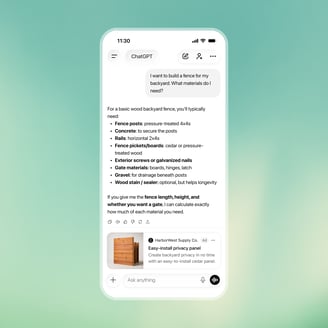
Ad targeting is currently limited to eligible users on the Free and Go plans. Plus, Pro, Business, Enterprise, and Edu users don't see them.
How Does ChatGPT Decide Which Ad to Show?
Here’s where marketers’ ears might perk up.
OpenAI, the company behind ChatGPT, looks at the context and intent of the conversation to determine which ads may be relevant.
If multiple ads are eligible, relevance and the advertiser's bid can help determine which one gets the spot.
Personalization can play a role too, depending on the user's settings. But advertisers don't get to peek behind the curtain. You don't receive someone's chats, memories, or personal information.
So there’s still plenty happening behind that little “Sponsored” label. The size of your wallet doesn’t automatically allow you to barge into the user’s conversation whenever and wherever you please..
What Makes ChatGPT Ads Different From Other Paid Ads?
If you’ve run Google Ads before, parts of this probably sound familiar. Advertisers bid to get in front of a specific audience, and relevance helps determine who gets the spot.
The big difference is how the searcher’s intent manifests.
With traditional paid search, marketers typically target keywords related to what someone types into a search engine. Meanwhile, ChatGPT has the context of an ongoing conversation. A person could spend several messages describing a problem before an ad ever enters the picture.
That gives advertisers the potential to show up during a pretty interesting moment: while someone is actively researching a problem and figuring out what to do about it.
|
ChatGPT Ads |
Google Search Ads |
|
|
User behavior |
Having a conversation |
Performing a search |
|
Context |
Can consider the current chat |
Primarily based on the search query |
|
Placement |
Below a ChatGPT response |
Atop search results |
|
Paid influence on organic answer |
None |
None |
|
Maturity |
Brand-spankin’ new |
Your grandpa’s digital ad platform |
Okay, Google Ads launched in 2000. Maybe not your grandpa’s. But you get the point.
That maturity difference does matter, though. Google advertisers have years of benchmarks and established practices to lean on. With ChatGPT ads, marketers are still figuring out what a good campaign even looks like.
What Does Advertising on ChatGPT Look Like for Marketers?
Here’s where the shiny, new ad platform starts feeling a little more like the ones you already know and love (or hate). You have targeting choices, bids, ad creative, and performance data to work with.
The difference? We’re still early. Very early. Nobody has a dusty, 200-page ChatGPT Ads Best Practices guide sitting on their desk yet.
Targeting and Ad Personalization
ChatGPT ads start with context and intent. OpenAI can look at what someone is discussing in their current conversation and match that conversation with relevant advertisers.
Advertisers can provide their own targeting selections and context hints, while OpenAI considers the ad’s landing page, title, and copy when finding a match. If the user has ad personalization turned on, signals from past chats, memory, and previous ad interactions may come into play too.
That does not mean marketers get a backstage pass to someone’s ChatGPT history. Advertisers don’t receive chats, memories, names, emails, or other personal details.
Bidding and Ad Relevance
Money talks, but apparently it doesn’t get to yell over relevance.
When multiple ads are eligible to appear, OpenAI says both advertiser bids and relevance can determine which ad gets shown first.
That makes your bid only part of the equation. Your ad still needs to make sense within the conversation for ChatGPT to consider showing it.
What Can You Measure?
For now, the reporting side is pretty bare-bones. OpenAI says advertisers receive aggregated, non-identifying performance data, including:
- Ad views
- Clicks
Yep, that’s it for now. OpenAI may add more measurement options over time. For now, marketers considering ChatGPT ads will have far less performance data to work with than they would on a more established advertising platform.

Is Advertising on ChatGPT Worth It for B2B Companies?
That’s the million-dollar question. Or, preferably, the considerably-smaller-test-budget question.
There’s a good reason for B2B marketers to be curious about advertising on ChatGPT. People are already using ChatGPT to research problems and weigh purchase decisions. An ad has the chance to appear while that research is already happening, rather than hoping someone searches for the right keyword later.
But potential is doing some heavy lifting there.
ChatGPT ads are still too new for marketers to have years of benchmarks showing what campaigns should cost or how they perform across B2B industries. OpenAI’s current reporting is limited, too. That makes it difficult to predict ROI before putting money into a campaign.
For now, we’d treat ChatGPT ads in 2026 as an experiment rather than a replacement for channels already producing results.
|
Worth a Test |
Maybe Sit This One Out for Now |
|
You have budget set aside for experimentation |
Your paid media budget is already stretched |
|
Your buyers use AI tools during research |
You have little reason to believe your audience uses ChatGPT |
|
You have a clear offer and landing page to test |
You’re still working out your broader paid strategy |
|
You’re comfortable learning without established benchmarks |
You need predictable ROI before investing |
Being early has its perks. You get a chance to learn how your audience responds while everyone else is figuring out how ChatGPT ads work from the advertiser side.
Being early also means being the guinea pig.
For most B2B companies, that’s probably the fairest way to frame the opportunity. ChatGPT ads may deserve a piece of an experimental budget. There simply isn’t enough performance history yet to justify yanking money away from campaigns already bringing in qualified leads.
Should You Advertise on ChatGPT Yet?
Advertising on ChatGPT is worth watching and, for some B2B companies, worth testing. Just don’t ditch channels that are already producing results to chase the new shiny thing.
If you have room to experiment, start small and see what you learn. After all, the ChatGPT ads party is just getting started.
Get More Eyes on Your Brand
ChatGPT ads are one way to get noticed. Our 4 Ways to Build Brand Awareness e-book has a few more.
How to Audit your Online Marketing
If you are executing digital marketing, congratulations! You are most likely already one step ahead of your competition, and making strides to meaningfully connect with prospects online. But, how do you know if you’re seeing continual success year over year, and improving your metrics?
Without the tools in place to analyze and benchmark your efforts, it is impossible to scale your online marketing and ensure continuous success.