
"Your brand is your promise" is an old and oft-repeated quote.
In the case of B2B companies, branding is your hook. In many industries, it's the only thing that differentiates you from the competition.
Think about it. There's only so much you can do to improve the performance or cost efficiency of a manufactured product. At some point, all of the options level out and blur together to the average purchasing agent. When you get to that point, how do you convince a buyer that your product or service is better than the other guy's?

That's where B2B branding comes in. Brand awareness means you have a leg up when your buyer is comparing vendors. They're more likely to interact with you, read your content, and convert into a lead or sale.
Are you taking that extra step? Compare your company and your stances against these eye-opening statistics ...
14 B2B Branding Statistics
#1: Among B2B buyers, 44% are highly relationship-oriented.
---McKinsey
What this means to you: Industrial and manufacturing OEMs tend to stick to patterns with which they're familiar. Historically, this market is slow to try new experiences and suppliers, even when they're not thrilled with their current situation.
#2: Among employees with purchase influence, 72% prioritize long-term relationships over a fresh point of view.
What this means to you: The most important element of that relationship is reliability. Fair or not, your digital branding contributes to your reputation regarding reliability. If your brand's vibe is inconsistent, unclear, or hard to trust, it won’t matter how “innovative” your messaging is. Strong branding builds familiarity over time, like a cozy blanket you come to for support.
#3: B2B customers are more than 2x as likely to consider a brand that shows personal value over business value, because they perceive little difference in the business value between suppliers.
What this means to you: The issues here are twofold. First off, if a buyer is perceiving little difference, it may be because you're throwing out the same vague claims (great customer service, high quality) that everyone makes. Try getting more specific and deep with your value propositions.
Secondly, B2B buyers are still human beings. They want peace of mind, external validation, and so on. Tie your branding messages to those personal pain points, and you'll succeed, no matter how "boring" your product or service is.
#4: About 45% of people chose "too much self-promotion" as the thing that would most likely cause them to unfollow a brand on social media. Second place: automated messaging (34%).
What this means to you: This statistic is telling you that if you respect your audience's time and intelligence, it'll respect you back. Bland, impersonal, and overly pat-on-the-back messaging is never going to win eyeballs and customers on social media. Do we really need to explain this one?
(Related Resource: 25 Ways to Increase Brand Awareness With Inbound Marketing)
#5: Among B2B buyers, 88% trust a brand if it shares valuable content.
What this means to you: Sales-y content is inherently untrustworthy, no matter how genuine your company is. Your content needs to build trust through usefulness. If your content consistently helps buyers solve problems or understand their options, you earn credibility long before a sales conversation ever happens.

#6: "Generating high-quality leads" is the biggest challenge for 58% of B2B marketers.
What this means to you: Are you narrowing your message to appeal to the right buyer persona? If you’re attracting the wrong audience, no amount of nurturing will fix it. Clear positioning and branding help you draw in prospects who actually belong in your pipeline.
#7: Specific to content marketing, B2Bs' top challenges are: creating content that prompts a desired action (40%); time, people, or budget constraints (39%); and measuring results (33%).
---Content Marketing Institute
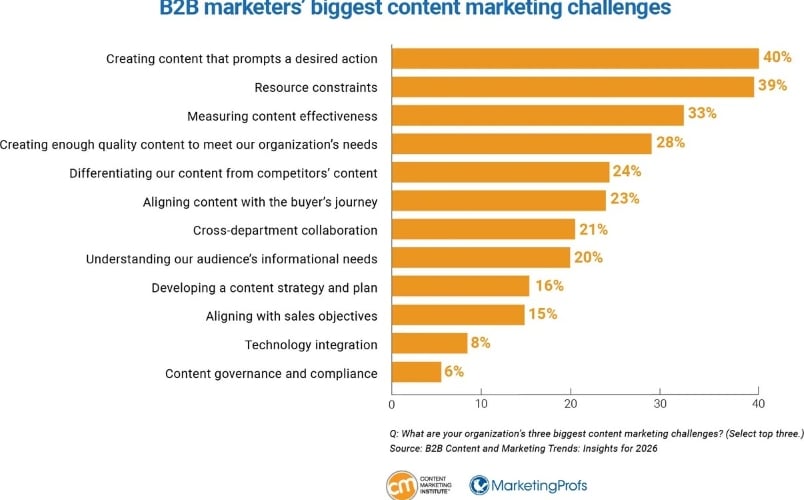
What this means to you: This statistic notes that when B2B content struggles, it's often because the output is disconnected from outcomes. Yes, content should boost traffic to your site, but it also needs to guide buyers toward action once there. Without a clear strategy tying content to conversion and revenue, even James Patterson-level writing would lose the plot.
#8: Among B2B marketing leaders, 77% say branding is critical to growth.
What this means to you: While branding strategy plays a smaller role in success for B2Bs vs. B2Cs, it still deserves attention and love. When your brand is clear, consistent, and easy to recognize, it shortens sales cycles and makes every marketing effort more effective.
#9: An average of 13 people inside the buyer's company (and nine outside!) are involved in the purchase decision.
---Forrester
What this means to you: As customers consider future purchases, they rely on a vast network of peers inside and outside their building. B2Bs that understand and engage the entire buying network, across all buyer journey phases, will gain a competitive advantage.

#10: Among B2B buyers, 73% report transactional experiences that ignore emotional needs.
---Harvard Business Review Research
What this means to you: It means a big opportunity for you to set yourself apart from competing brands. Remember, B2B buyers have hearts and brains, too.
#11: Brand marketing is handled entirely in-house by 35% of B2B companies.
What this means to you: When branding is split across internal teams and agencies, and you poorly communicate it, consistency can break down. Of course, keeping branding and marketing work in-house doesn’t guarantee good results. Without strong and consistent messaging, positioning, and voice, even a fully internal team will struggle.
#12: Among large B2Bs who outsource, 84% say content creation is the activity they seek the most help with ...
---Content Marketing Institute
What this means to you: This makes sense. It takes more than engineering knowhow to get a point or tip across. B2B content writing requires a grasp of:
-
Search optimization – How to make your pages appear in Google and AI search results for the right audience
-
Conversion paths – How to keep those people on your site longer
#13: ... However, 89% of B2B marketers (whether in-house or at an agency) are using AI to generate or optimize written content ...
What this means to you: It depends on whether you're the boss or the implementer. Some bosses, sadly, think of AI tools solely as a way to dispose of human marketers and save some money. This is not the way.
Then you have the implementer side, which – also sadly – sometimes uses AI in the wrong way and for the wrong reasons. AI cannot replace human creativity. And it shouldn't be doing your brand messaging for you.
Dumbassery in AI marketing is too broad a topic to cover in-depth here, so here's a link instead.
#14: ... Of that group, 39% say content performance has gotten better, 34% say there’s been no change, 5% say it’s gotten worse, and 22% are unsure or believe it’s too soon to tell.
What this means to you: Efficient or not, AI's true success comes down how you use it. Teams with clear branding and content strategies are more likely to see gains, while those using AI as a mindless copy-paste exercise often see flat results.
Main Takeaway for B2B Companies
To stand out, industrial and manufacturing businesses need to strengthen their brand and connect with buyers on a deeper level.
Want to generate more leads with your B2B marketing approach? You have to understand your buyer. There's too much impersonal B2B information online. To break through the noise, you need to appeal to who they are as a human being.
How to Audit your Online Marketing
If you are executing digital marketing, congratulations! You are most likely already one step ahead of your competition, and making strides to meaningfully connect with prospects online. But, how do you know if you’re seeing continual success year over year, and improving your metrics?
Without the tools in place to analyze and benchmark your efforts, it is impossible to scale your online marketing and ensure continuous success.